Bag Palletising Robots: How the Process Works
See how filled bags are picked, transferred and placed in pallet layers. Review bag variation, arrival spacing and recovery before a handling trial.
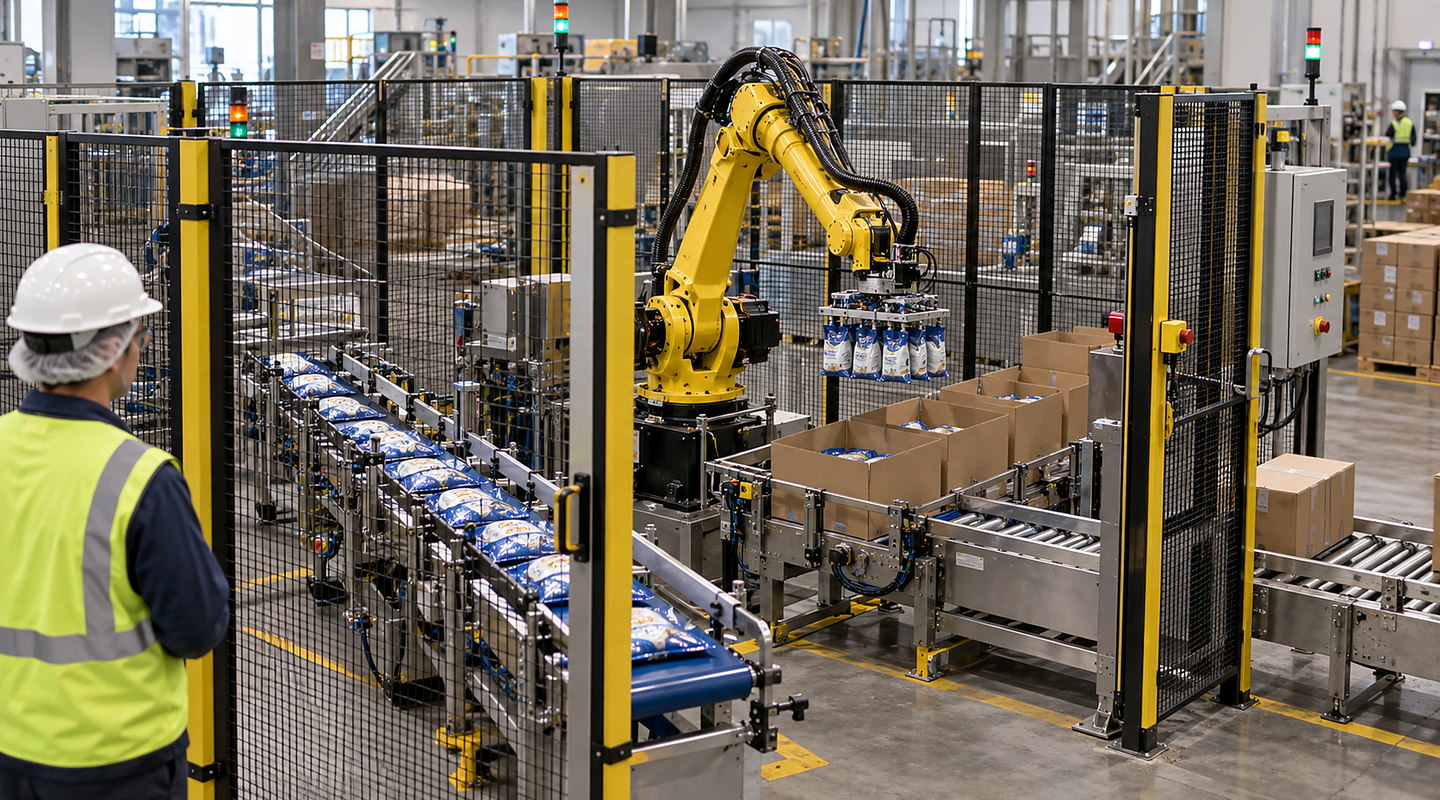
Illustrative robot case-packing line.
A bag palletising cell picks a filled bag from the defined arrival position, transfers it and releases it in the required pallet layer. The handling concept must be trialled with the actual bag weight, shape and surface condition, including the bottom and final layers.
Define bag orientation and spacing at the pick point, pallet dimensions, stack height and the response to damaged bags or interrupted cycles. Judge the complete handling sequence and recovery requirements rather than robot speed alone.
Follow the filled bag from arrival to its pallet layer
Show how bags arrive, where the gripper picks them and how they are released into the agreed pallet pattern. Review the whole range of bags and layer positions, then include damaged-bag handling, access and interrupted-cycle recovery in the trial plan.
Discuss your application

Four clear stages for bag palletising robots
Use actual filled bags and a defined pallet result to decide what must be demonstrated at each project stage.
- 01
Define the bag range and arrival
Record filled-bag weights, dimensions, materials, closures and surface condition. Observe orientation, spacing, short gaps and interrupted supply at the proposed pick point.
- 02
Trial pickup, transfer and release
Use representative normal and difficult bags to compare the handling concept. Review the gripper through the agreed pallet layers, including the bottom and final layers.
- 03
Connect the delivery and cell interfaces
Define arrival signals, pallet layout, operating modes and the conditions that stop or restart the process. Review operator access, maintenance and application-specific risk controls.
- 04
Run the agreed production and recovery checks
Agree the bags, layer pattern, output requirement and damaged-bag or interrupted-cycle cases. Record expected outcomes, observations, exceptions and the actions needed before handover.
Decisions and results stay connected
| Stage | What happens | What you can review |
|---|---|---|
| Define the bag range and arrival | Bound the filled-bag range and the arrival conditions at the pick point. | Representative bags, orientation and spacing records, pallet dimensions and stack height. |
| Trial pickup, transfer and release | Trial how the proposed gripper picks, transfers and releases the bags. | Observations across the agreed bag range and pallet layers, including bottom and final layers. |
| Connect the delivery and cell interfaces | Resolve delivery signals, operating modes, access and recovery responsibilities. | Layout, line handshakes, stop/restart conditions and any unresolved interface assumptions. |
| Run the agreed production and recovery checks | Demonstrate agreed normal, damaged-bag and interrupted-cycle cases. | Expected versus observed outcomes, repetitions, exceptions and actions for production handover. |
Keep connected responsibilities clear
Your final bag palletising robots scope must also account for operator access, recovery and changeover, run-off criteria and production evidence, current regulations and the conditions at your site.
- Cycle time depends on the complete process rather than robot speed alone.
- Part presentation, tolerances and recovery cases must be included in feasibility work.
- Collaborative operation or automatic handling cannot be assumed safe without an application assessment.