Bag Palletising Robots Run-off and ramp-up checklist
Plan bag palletising acceptance checks around representative bags, pallet layers, damaged bags and interrupted cycles. Agree the test method and records.
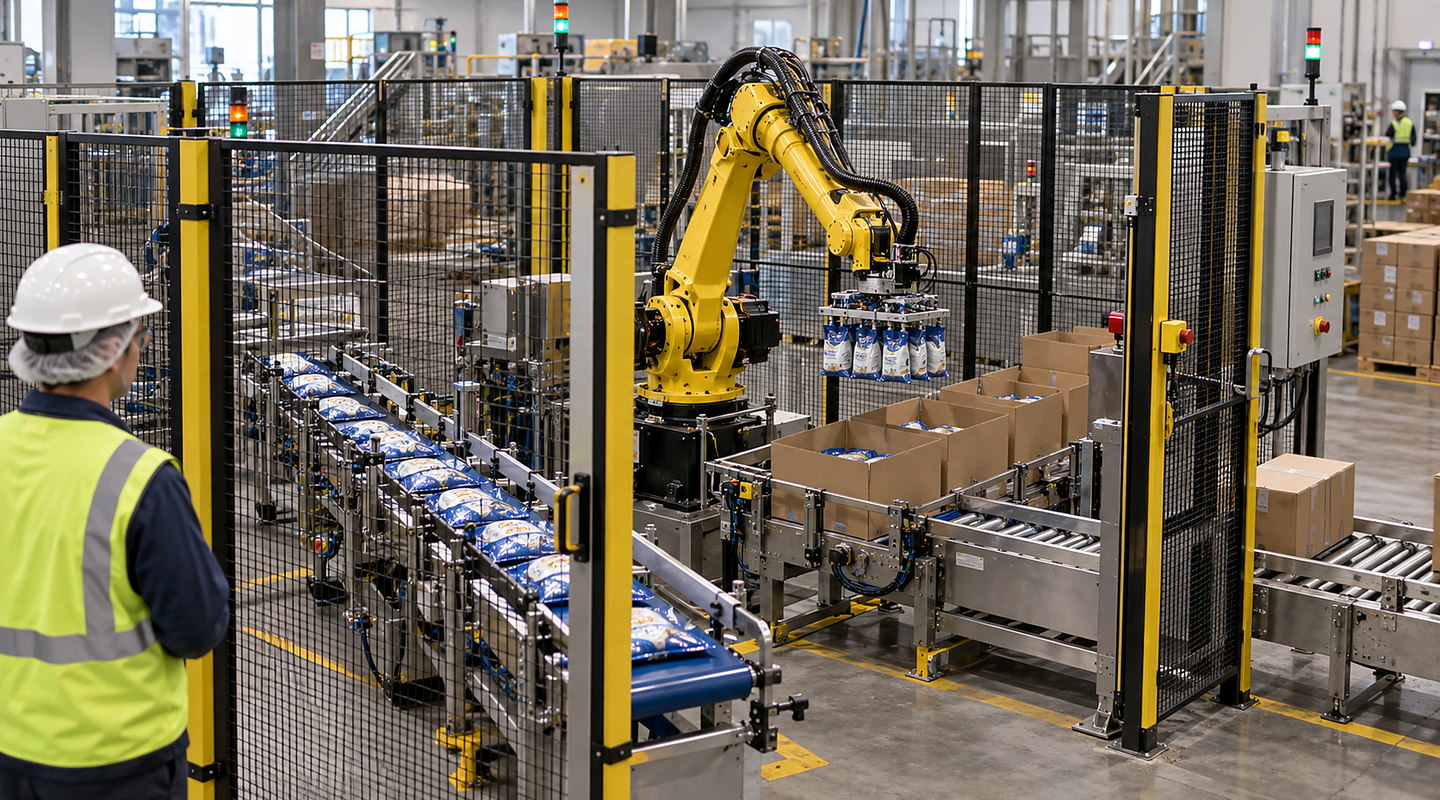
Illustrative robot case-packing line.
In brief
Agree the bag range, pallet pattern and expected handling result before the trial. Use representative bags to check pickup, transfer and release across the pallet layers, including the bottom and final layers, then record the outcome under the agreed production conditions.
Include damaged bags and interrupted cycles, with a defined recovery response. Agree the method, repetitions, acceptable results and record before testing; these are proposed acceptance checks, not a claim of achieved output.
On the production floor
Turn your production information into clearer decisions — Bag Palletising Robots
Plan bag palletising robots around your parts, process, cycle time, tooling, recovery and acceptance criteria. Discuss the highest-risk feasibility questions with Oxford Industrial Automation. Use this guide to resolve run-off criteria and production evidence before it limits the final system.
Run-Off Criteria and Production Evidence: condition, range and effect on your process
Current condition
Describe how you observe or measure run-off criteria and production evidence in your operation, including sample condition and any measuring limits. For a project focused on robotic palletising of filled bags, also record the production state in which each observation was made.
Realistic range
For Bag Palletising Robots, include normal production conditions, credible extremes, product or part variants and changes over time.
Effect on the system
Show which settings, safeguards, maintenance tasks, decisions or required outcomes are affected by changes in run-off criteria and production evidence.
Before you contact us
Five questions about run-off criteria and production evidence for your application
Who can confirm this information?Identify the person responsible for run-off criteria and production evidence in production, quality, engineering or operations.
How representative is the sample?Include age, supplier, batch, environment and upstream process state where they affect bag palletising robots.
What is the difficult condition?Include the slow, reflective, flexible, dirty, damaged, marginal or uncommon case that your system must still handle.
How will you judge the result?Agree the method, repetitions, acceptable range, result record and the response if the observed result falls outside the agreed range.
What else must be coordinated?Your final bag palletising robots scope must also account for operator access, recovery and changeover, run-off criteria and production evidence, current regulations and the conditions at your site.
Connected details
Review run-off criteria and production evidence as part of the complete system
Question 1
Representative filled bags
Include the agreed weights, dimensions, materials, closures and normal or difficult shape and surface conditions. Identify the bags used so the handling observations can be traced to the tested range.
Question 2
Arrival and presentation
Trial the agreed orientation and spacing at the pick point, including short gaps and interrupted supply. Record the arrival condition alongside the observed handling result.
Question 3
Pickup, transfer and release
Observe how the proposed gripper picks, moves and releases the tested bags. Compare the result with the agreed handling requirement rather than judging only a successful initial pickup.
Question 4
Pallet layers and stack height
Use the agreed pallet dimensions, pattern and stack height. Include the bottom and final layers when assessing how bags are placed and released.
Agree the method, repetitions, acceptable outcomes and result record. Keep exceptions and actions where observed handling or recovery falls outside the agreed requirements.